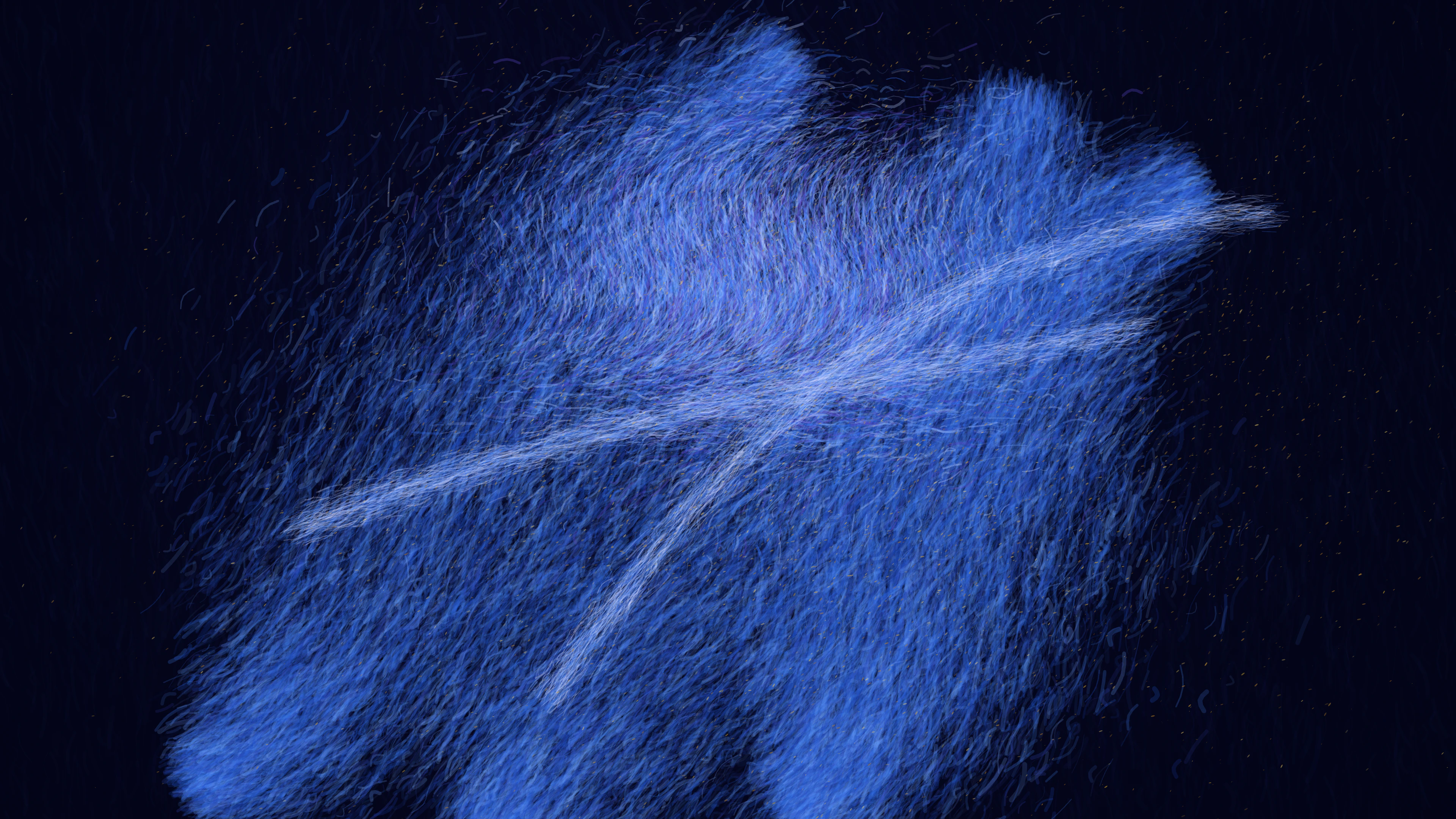
01 / Brief
Quantity entered the studio. Taste decided what left.
The run asked parallel coding agents and 16 external model routes to make large canvases across Arctic light, mountains, gardens, storms, cathedrals, biblical subjects, and open prompts. Every weak render stayed in the research archive. Only full-resolution works that survived a second visual inspection entered the exhibition.
No image-generation model was used. Models wrote executable painting code or directed a local mark system; optical studies disclose their public-domain reference geometry and repaint it with recorded marks.
02 / Ledger
The rejection count is part of the result.
03 / Method
Three ways to paint. One visual gate.
A model chooses the subject, composition, palette, and every drawing instruction inside the bounded brush environment.
Independent coding agents build deterministic canvases, inspect proofs, rewrite weak branches, and promote only surviving compositions.
Public-domain image geometry is resampled into hundreds of thousands of disclosed bristle marks, with the source and transformation retained.
04 / Record
Every accepted canvas keeps its making.
The manifest records title, prompt, subject, authoring route, provider, formal lineage, tool profile, exact mark count, source and output hashes, resolution, light/dark mode, source credit, and publication file. The exhibition is a two-column visual index; selecting a canvas opens its title, model or agent, methods, prompt, and 4K download.