02 / Brief
Can accumulation become a civilization?
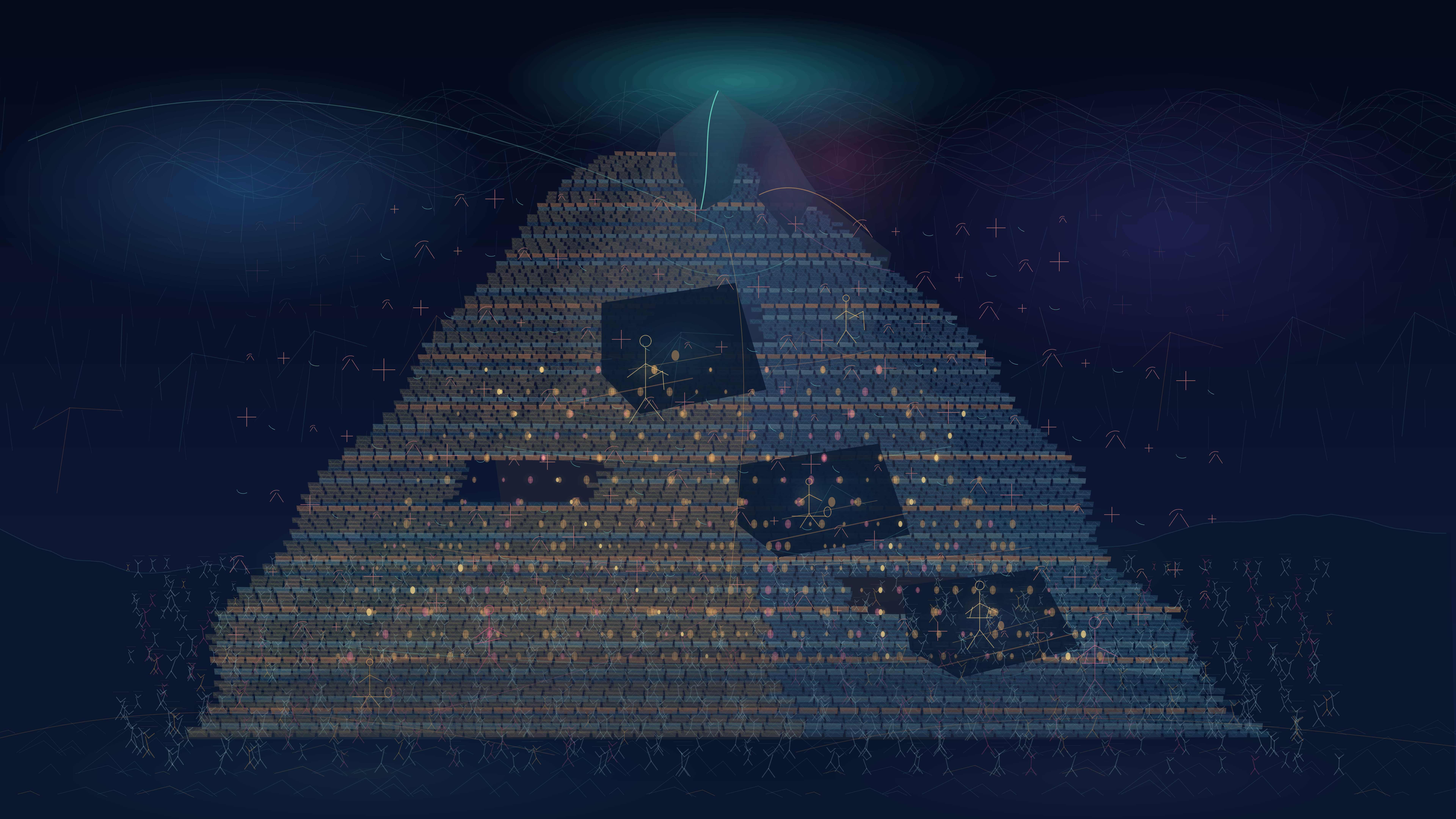
This is one sustained work, separate from the ten-model Babel comparison. Its city is made from thousands of small decisions: masonry courses, lanterns, bridges, workers, processions, courtyard rituals, scaffold lines, and fragments of language escaping into the weather.
Tower of Babel as a civilization building one impossible vertical city while language fractures into weather, light, procession, and living masonry. Monumental at a distance; human at close range. At least 50,000 meaningful paint operations. Full creative freedom.
03 / Collaboration
24 calls / 05 roundsFive routes argued. One canvas remained.
The process began with five independent directions, followed by visual critique, parallel complete-source revisions, a second critique, and a final jury. Luna, Inkling, DeepSeek, and Qwen pushed the tower away from a centered diagram and toward asymmetry, inhabited thresholds, weather, and a luminous split crown. Ox Alpha supplied an initial direction before later requests were rate-limited. Codex rendered the viable branches and synthesized four successive canvases; only the fourth became the master.
The ledger records 24 provider attempts: 18 successful responses and six failed requests, 130,371 tokens, and $0.19010190 in recorded provider cost. Three model-authored revision branches rendered; Qwen’s branch was incomplete and failed JavaScript validation. Failed and rejected work remains in the private experiment record rather than being disguised as part of the final.
04 / Replay
55,137 / 01The tower keeps its construction.
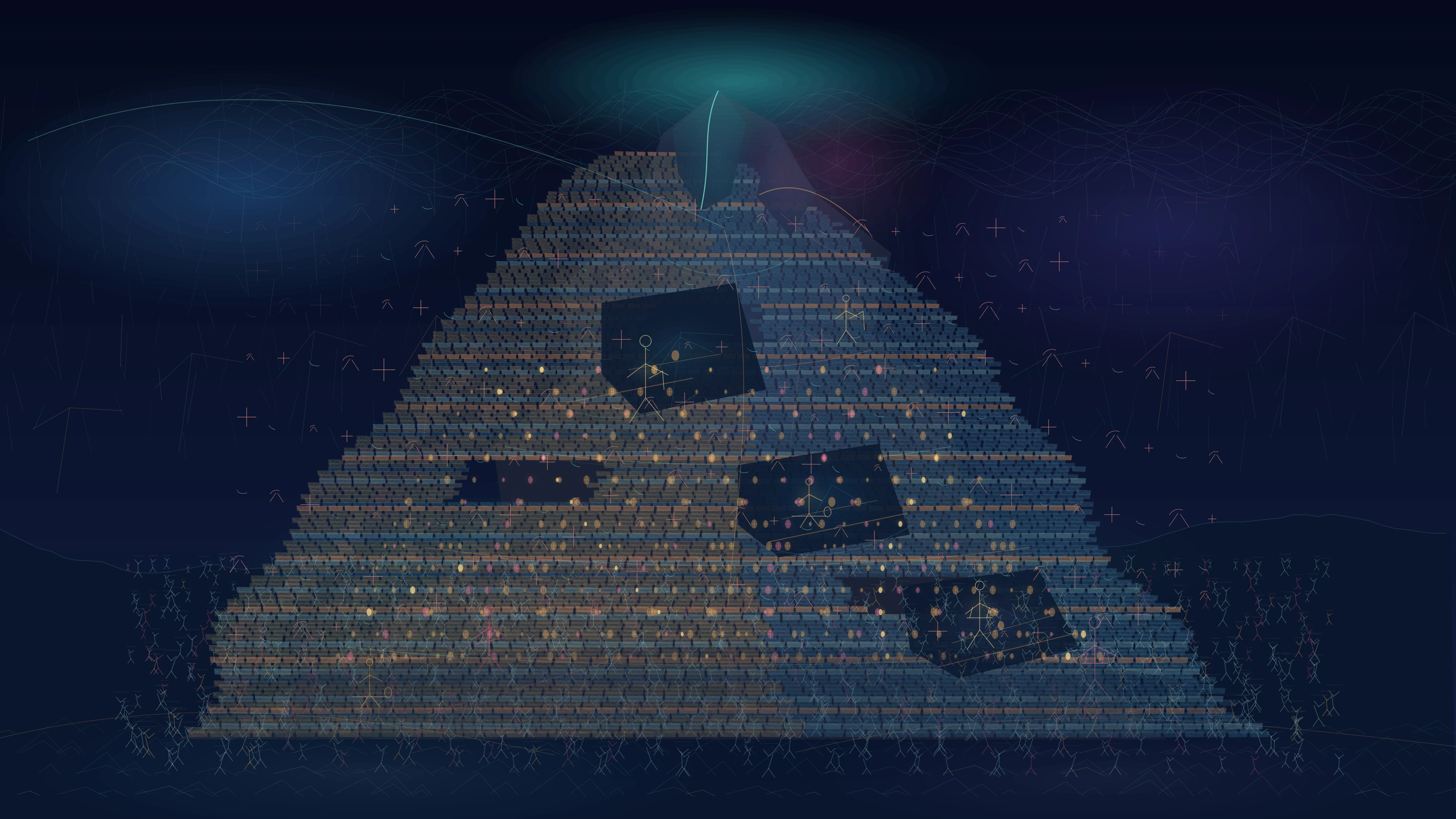
The replay is generated from the final source—not a crossfade between finished pictures. The renderer observed 55,137 drawing operations, captured 93 cumulative checkpoints, and selected 80 evenly distributed construction states. Sixteen final hold frames make the completed city legible before the loop begins again.

05 / Record
SOURCE → 8K → GIFThe claim is inspectable.
- Final canvas
- 7,680 × 4,320 PNG and WebP
- Logical canvas
- 2,048 × 1,152
- Renderer
- Local p5.js / p5.brush complete-code pipeline
- Replay
- 1,024 × 576 GIF · 80 source states · 16-frame final hold
- Final pass
- Version 4 after Inkling’s visual jury
- Image model
- None
- Fixed scene template
- None
- Published source SHA-256
- 907caa5a228e2845dc13c25ac25ba7ca63a6c5a0513a2484435dedc3663228ff
- 8K PNG SHA-256
- cbece35f1d8ff314de8dbe541bd29fc5dd4233c9c2afaefd53aa7991b2a3fc0f
- GIF SHA-256
- 4a249411fc3a75dc264b88bf410512220e8619a1b5b3a4d70f62bf17adc36e9d
- Manifest
- Machine-readable record
06 / Boundary
HONEST LEDGERWhat the number means.
“55,137 operations” is the renderer’s instrumented count of wrapped p5 drawing calls and structural checkpoints, not 55,137 individually hand-painted brush dabs. Density is concentrated in the masonry, processions, lanterns, language weather, and foreground. The GIF is a 1,024 × 576 replay, while its final state is an exact downsample of the approved 8K master. Full request, generation IDs, usage, failures, dimensions, hashes, and renderer build are in the manifest.